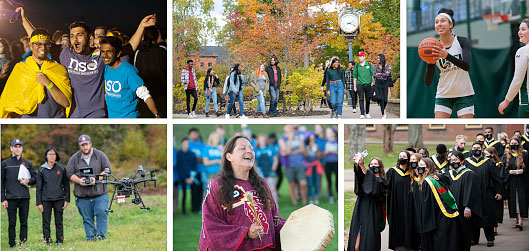
Graduation Day 2009
The following twenty-one Inuit educational leaders are the first graduates of the Nunavut MEd program. The day before their convocation ceremony, they presented the results of their final research projects at a closing symposium. The graduates and their research are introduced below.
“Coming to know the past has been part of the critical pedagogy of decolonization.” Saa uses this statement by Linda Tuhiwai Smith to frame and map her narrative of the Lake Harbour Relocation – “the before” and “the after.” Three Elders provided the details of the lives of Inuit prior to relocation: self-sufficient and nomadic, thriving on their skills and local resources. Three adults shared their life experiences living in two worlds: traditional versus contemporary. Saa was three when her family was relocated and draws on the details of her own memories as well.
Leaving a cooperative culture where men, women and children worked together and shared resources, the children began formal schooling, predominantly in English, where individuality and competition took over. A chasm opened between children and their parents.
Saa envisions a new tomorrow: a way of learning that reconnects the Elders from before and the children of now.
Tracing her personal history and the evolution of her multiple identities as teacher, leader, language advocate, community and family member for whom “Nunavut is very much a part of my life’s work as an educator,” Millie Kuliktana writes an autoethnographic account of events and influences that have shaped her into “an ‘Elder in Training’, striving for stronger language and culture programs that develop ‘whole’ students with opinions that culture has language and that language has culture.”
In powerful and poetic language Millie writes about her own experiences and challenges providing a narrative text that is itself an historical document about the evolution of education in Nunavut. Documenting the efforts to revitalize the Inuinnaqtun language, and in Millie’s own words, ensure that the “song for the dance of Inuit Qauyimayatuqangit” becomes a shared vision for all educators, this research provides testimony of the commitment to change that will enable young people to become Inummarik, capable of living and leading in a modern Nunavut.
In her autoethnography, Peesee Pitsiulak traces her family's journey from a semi-nomadic way of life with a father who was a traditional hunter and “part of the land as the rocks belong to the land” to life in a settlement. The older Inuit regularly said to them, “Do not go against the Qallunaat. They know a lot more than us.”
School imposed a foreign language and culture, a place where living by a clock as opposed to the traditional daylight and seasonal rhythms symbolized the drastic change between life on the land and life in the settlement.
Peesee reflects, “I am grateful that I have been educated both by my traditional parents and the formal education system. We will never go back to the way our grandparents lived but we still have to live according to their values and belief systems.”
Maggie Kuniliusie explores her “stratified identity” in this auto-ethnographic study. She reflects on her experiences and interviews her mother, tracing the erosion of traditional ways of collaboration and sharing while celebrating her family’s versatility. Her grandfather, who could bring in a boat full of walrus meat, became a Special Constable who spearheaded the establishment of the RCMP detachments in the Arctic region. Her father, a fine hunter, made a living as a government mechanic. Her mother, who “could magically turn any ordinary animal skin into beautiful clothing with vibrant patterns and designs,” was a teacher. Maggie has experienced settlement life and change, public schooling and undergraduate and graduate education, and a wide range of positions, which have helped her to achieve her present position and educational standing. “As a result of my parents’ strong cultural identity and versatile personalities,” she writes, she has succeeded in living, “between two cultures and between two worlds.”
Monica Ittusardjuat begins her autoethnography with the story of a teacher who raged at the worthlessness of his Inuit students. Monica describes how her residential school experience affected her identity very clearly: “I think I lost myself.”
When Monica returned to a culture she hardly knew, her parents selected a husband for her. Abused in residential school, her husband “had lost his identity, his self-respect and self-worth. He couldn’t trust anyone... and I wasn’t any better.” During their painful and turbulent marriage, Monica’s baby daughter was given in traditional ‘custom adoption’ against her will. She now cares for her grand-daughter and concludes with hope and pain, “I think I know who I am now but I don’t know who I was at the age of seven-eight. Just let me grieve for my lost childhood for a while.”
A resident of Arviat and long-term educator now working for the Department of Economic Development and Transportation, Elisapee Karetak is concerned about the implementation of Inuit Qaujimajatuqangit, the set of principles intended to guide the Government of Nunavut in its integration of Inuit traditional knowledge into its day-today operations. Her research focuses specifically on the subtle distinction between Inuit Qaujimajatuqangit (Inuit experiential ancestral knowledge) and Inuit Qaujimajangit (Inuit experiential knowledge) as a way of understanding more deeply the connection between the traditional and contemporary in Inuit life today. Drawing from her own experience, current events, and educational theorists, she points to the danger of reducing Inuit Qaujimajatuqangit to a set of static principles. She argues for a more fine-grained and dynamic understanding of Inuit Qaujimajatuqangit and how it can be lived in contemporary Nunavut.
“As our lives as Inuit have been so deeply changed by colonization it is important that I try to reach back to the knowledge that people of my mother’s generation possess... to better understand my own past.”
Mina achieves this through conversations with an Elder, her mother, about the traditional lifestyle of the Inuit on the Belcher Islands before they moved to the permanent settlement of Sanikiluaq. This “reaching back” is part of the process of increasing their Qaujimajatuqangit – their knowledge of Inuit beliefs, laws, principles and values as well as traditional knowledge, skills and attitudes. This autoethnography is framed by Mina's understanding of culture: “Culture influences how I think... It shapes every part of who we are.”
Leesie Akulukjuk spent her early childhood living in a settlement, but her later childhood was spent living with her family in the traditional way on the land. This “meant helping one another and caring for each other because in those days one could not live alone without regard for other people.” Leesie and her family moved back into modern society in Pangnirtung after living on the land for a number of years.
As an adult Leesie became interested in Inuit folk medicine that “does not have buildings, books or rules... it is shared knowledge.” To learn more, she interviewed Elders and discovered that Inuit medicines were based on three elements: plants such as Mountain Sorrel, animals such as caribou antlers, and direct treatments for illnesses such as snow blindness. As a result of her inquiry, Leesie intends to prepare teaching documents so that this important aspect of Inuit culture will survive.
In this paper, Nunia Qanatsiaq focuses on tunnganarniq, one of the eight Inuit Qaujimajatuqangit principles established by the Government of Nunavut. Tunnganarniq offers educators in Nunavut “a way to think deeply about how Inuit Qaujimajatuqangit can be more fully achieved in our schools.”
Tunnganaqtuq is defined as “to be approachable, hospitable, humble, kind, and generous, honest, respectful. In Inuit culture tunnganarniq is one of the moral laws.” Nunia's concern is for “the forgotten students” – the ones who may become more engaged in schooling if they feel accepted, acknowledged, and respected. She uses her own stories and experiences and the advice and wisdom of the Elders, to develop concrete proposals for integrating the Inuit concept of giving and sharing.
As someone who survived the residential school experience, Lisi Kavik knows first-hand the value of traditional Inuit culture and the devastation that results from attempting to supplant it with another.
While her research does not shy from the colonial legacy of the residential schools and the post-colonial legacy of much recent settlement schooling the roles, it points the way to a more hopeful alternative. Drawing from her own experience, relevant literature, and the perspectives of nine community interviewees, her research argues for the need for consistent support for Elders in schools as a way to support Inuit cultural survival and individual and collective well-being. Although her research leads to specific, practical recommendations to support such programs, it also points to a vision of the school as a place where learning is shared equally across generations and cultures.
Nunavut schools are mandated to promote and practice Inuit Quajimajaqangit (IQ) but what does this mean and what does it look like? As co-principal, Lena Metuq worked with colleagues to make eight IQ principles of behaviour the driving force of their school. She kept records and a reflective journal. With Inuit and non-Inuit staff, students took part in seasonal activities, learned traditional skills, engaged in collaboration and service. Barriers to implementation were a non-seasonal school timetable and lack of adequate funding for vital activities such as Spring Camp.
Lena observes that, “students become different when they are learning their language and culture. They shine... Their other strengths come out. When they are in their environment where there are no walls, they are different. When they work with Elders they are respectful, observant and try new things.”
Total Physical Response (TPR) is a method of teaching language using physical movement to respond to verbal input in order to reduce student shyness when learning a new language.
In Kugluktuk, located in the Kitikmeot Region of Nunavut, the use of the Inuinnaqtun language is declining and the children speak mostly English. Susie Evyagotailak wanted to find out if the TPR immersion approach could “become a major tool in revitalizing the language.” She used interviews, group discussions, observations, previous school activities and writing folders to find evidence of Bauman’s five specific goals for language teaching (to prevent its decline, to expand its role, to fortify its base, to restore its vitality and to revive its use) in the teaching of Inuinnaqtun.
As a high school teacher, Shuvinai Mike worried about the number of grade ten students who failed to graduate: “It breaks my heart when I see students struggling in the same grade for two or three years.” Her concern persists in her present position as the Director of Inuit Qaujimajatuqangit at the Department of Culture, Language, Elders and Youth and led to her research question, “Are they dropouts or push outs?” Shuvinai speculates that the Anglo culture of high school, “with its differences in communication styles between home and school,” as well as the practice of streaming students, are major factors. Her interviews with teachers, students and parents elicited concrete suggestions including modular units, evening classes, more Inuit teachers and permanent homeroom teachers.
Darlene Gibbons called on the experience of three generations of Inuit women – her mother, herself and her daughter – to formulate her research question: “How can teachers communicate successfully with parents?”
Her daughter's report card (from Arviat Middle School) was the immediate prompt. “Her report card was only one page and had no comments from her teachers. I had a hard time understanding it. I started to think about all the parents who are not educators.”
Interviews with parents and teachers revealed some common suggestions for improvement:
Both parents and teachers expressed the need for more comments in the two languages. Parents commented that they are open and would help with their child’s progress throughout the year.
Dinah Kavik has students who “decide to return or not to return to the same course year after year.” Would these students benefit if high school courses at Nuiyak School were modularized? Choosing different approaches for different groups, Dinah used individual interviews, a questionnaire and focus groups to gather opinions from 3 parents, 4 teachers, 7 high school students and 3 students who had dropped out of high school. Most, she concluded, believed that modularization would help the majority of students, though exceptions need to be recognized. She identified four other components: better information for parents and students; adequate resources for Inuttitut courses; a school year reflecting the seasons; use of age appropriate learning stages as in the Inuit tradition. Modularization and other changes require work and commitment from educators but we must not forget “it is the students we work for.”
Jessie Lyall sees students who are keen about high school in September but drop out later in the year. She wonders how they can be motivated to complete their education.
Jessie reflected on her own school experiences and gathered information from five of her former Grade 3 students, now in Grade 10. She heard that high school was difficult. Students told her that more hands-on work and connection with Inuit ways could help; Elders in the classroom and good Inuit counsellors were important. Jessie envisages inclusive sports activities and music, greater exposure to the “real learning environment” outside school, and learning to “share, appreciate and accept other cultures but live your own.” Teachers must be leaders who keep the needs and well-being of children clearly in focus and “stand firm like the tent I was born in, with strong rocks to keep it from falling.”
One of Mary Kavik's goals as a teacher is to "make school a place where Inuit culture is valued and real." Her research, centred on the saunik (name giving namesake relationship), emerged from a project with her Grade 10 and 11 students designed to demonstrate that "naming practices maintain a web of connections and relationships."
The students' assignment was to trace the saunik of family members. She interviewed the students two years later and elicited comments such as: "I was really proud. Even my great-grandmother was really proud;” “We must keep our culture strong so we don't forget our ancestors.” Locally, this was a collaborative project with students, teachers and the community. Nationally, it was linked with other schools through the Canadian Heritage Society Agora website.
As a young teenager forced to leave her small home community to attend the residential high school in Frobisher Bay, Elisapee Flaherty found her contact with her parents reduced to short phone calls. She persevered to complete her high school and become a teacher. Now an Inuktitut program consultant, she finds herself wondering about the importance of parental involvement in schooling, the extent to which it has improved since her experiences as a student, and what might be done to improve it further. Her current research explores these questions and draws upon her own experience, interviews with representative stakeholders, and a review of research on parental involvement in schools in other contexts. Although improved access to higher grades in small communities has increased the potential for parental involvement in Nunavut schools, she finds there remains room for improvement and suggests strategies for doing so.
How do members of a small community decide whether to continue to ban alcohol or re-introduce it? When Nancy Uluadluak’s community held an alcohol plebiscite, she sought out different perspectives and then realized that the lives of her high school students would be affected by the decision, and yet young people were not being consulted. Nancy sent an on-line questionnaire to recent high school graduates. Almost all who responded were against alcohol re-introduction. Some described local bootleggers and negative effects of alcohol on “people in town.” To combat these influences, Nancy proposes alcohol education in schools, creation of addiction support groups, and more space for recreation. She advocates greater youth involvement in community decision-making: “Today, life has changed and young people have dreams that Elders never experienced before. Dreams will allow them to move forward for a healthier life.”
Meeka Kakudluk has been concerned for some time with the imbalance between the percentage of Nunavut teachers who are Inuit (33 per cent) and the percentage of Inuit teachers who serve on the committees and executive of the Nunavut Teachers Association (NTA) (8 percent). She conducted interviews and distributed a questionnaire to probe the reasons for this disparity. One major reason emerged: many Inuit teachers feel uncomfortable calling the NTA offices, visiting or asking questions in Inuktitut when the operating language is English. Meeka likens this to Paulo Freire's concept of “limit situations” beyond which “people cannot imagine themselves.”
Meeka notes that since she began her research project, the NTA has changed “to reflect more of the cultural and linguistic situation in Nunavut.” The NTA Newsletter, the collective agreement and other documents are now published in both languages.